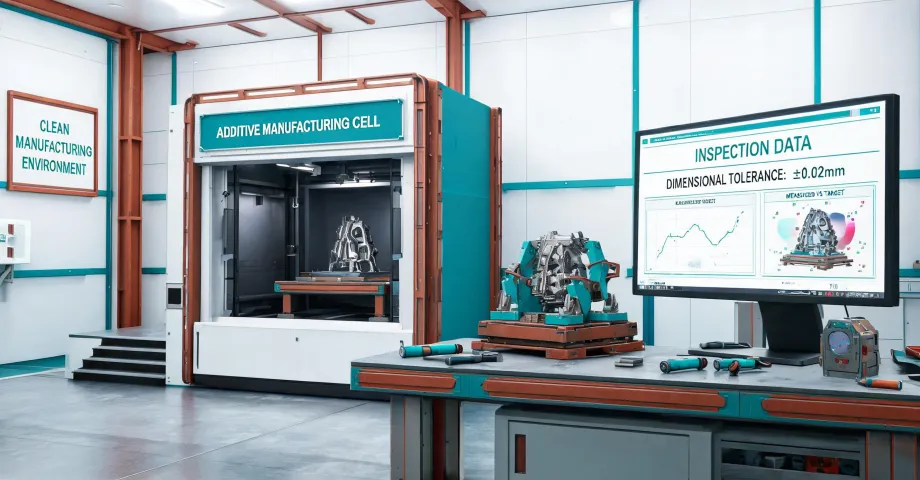
I'm a quality compliance manager at a mid-sized manufacturing company. I review every part that leaves our shop—roughly 200 unique items a year. In Q1 2024, we ran an audit that compared first-pass yield between parts made on a Markforged Metal X 3D printer and parts from a traditional injection molder. The results weren't a clean win for either side. That's the point of this article: there is no single “best” manufacturing process. The right answer depends on your volume, your design maturity, your material requirements, and how much traceability you need.
I don't have hard data on industry-wide adoption rates, but based on five years of orders, my sense is that companies are increasingly blending additive and traditional manufacturing. The 2020-era advice to “go all-in on 3D printing” or “only use injection molding” is outdated. What was best practice in 2020 may not apply in 2025. The fundamentals haven't changed, but the execution has transformed. According to ISO/ASTM 52900, additive manufacturing is the process of joining materials to make parts from 3D model data, usually layer upon layer. That definition keeps expanding as technologies evolve.
To help you decide, I've broken down the decision into four scenarios. If you're doing low-volume production with rapid design changes, start with Scenario A. If you're making high-volume, mature parts, go to Scenario B. If you're prototyping in an office, read Scenario C. And if you're wondering whether your 3D printer needs to be tethered to a computer, jump to Scenario D.
Scenario A: Low-Volume Production and Rapid Iteration
The biggest mistake I see is treating injection molding and 3D printing as interchangeable. For small quantities—say, under 1,000 units—and when the design will change several times, 3D printing wins on cost per part and lead time. The Markforged Metal X 3D printer is a good example. It's not the cheapest metal printer, but it's designed for shop-floor use, and the parts we've made for tooling inserts have held up well. In one project, we printed a batch of 40 brackets in 17-4 PH stainless steel. The alternative—machined parts—would have taken three weeks and cost $18,000. We did the whole run in five days for under $3,000.
This is where quality metrics matter. We checked every finished part against a coordinate measuring machine. All 40 met our flatness tolerance of 0.005 inches. That wasn't luck—it's the process repeatability we need for production-adjacent parts. To be fair, 3D printing isn't free from tradeoffs. You'll spend time calibrating support structures and post-processing. And the per-part cost advantage disappears above a certain volume. And before I trust any material claim, I ask for the data sheet. Per FTC guidelines, performance claims must be substantiated—that applies to a Markforged part or an injection-molded part alike.
Scenario B: High-Volume Production and Mature Designs
For high-volume production—think 10,000+ units per year—injection molding is still the champion. This is where basic injection molding knowledge pays off. Mold tooling is expensive, but the unit cost drops dramatically once you're past the break-even point. You need to account for tooling life, cycle time, and material shrinkage. A well-designed mold can produce millions of parts, and the repeatability is something most 3D printers can't match.
The third time we ordered a poorly drafted injection-molded part, I finally created a design checklist. That was after a $12,000 redo. Now we verify draft angles, wall thickness, and gate placement before we send anything to the mold maker. To be fair, injection molding has a steeper learning curve. But once you master it, the consistency is excellent.
Here's a data point from our Q1 2024 audit: in a production run of 15,000 snap-fit housings, injection molding gave us a defect rate of 0.8%, while a comparable 3D-printed batch would have been in the 2-3% range—and likely higher for dimensional consistency. But don't take that as a universal truth. Your experience will vary based on part geometry and the printer you use.
Scenario C: Office Prototyping with Desktop Printers
Now let's talk about the Bambu Lab A1 3D printer—sometimes listed as the “Bamboo Labs A1 3D printer” in search results. It's a popular desktop machine, and for office prototyping it's great. But it's not a manufacturing platform. Treating it as one is a common mistake. The A1 is fast and user-friendly, but its open-frame design means ambient temperature changes can affect warping and layer adhesion. If you're printing a prototype to check fit and ergonomics, that's fine. If you're planning to use that same part in a test rig with any mechanical load, you're taking a risk.
The counterintuitive advice here: don't buy a Bambu Lab A1 3D printer for “real” production parts. Instead, use it to run quick experiments that inform the design before you commit to a Markforged part or an injection mold. It's a design tool, not a manufacturing tool. That said, the A1 has a role in the workflow: it reduces the cost of iteration, which is a legitimate quality gain.
Scenario D: Do 3D Printers Need to Be Connected to a Computer?
The simple answer is no—modern printers like the Markforged 3D printer and the Bambu Lab A1 can operate standalone through WiFi, Ethernet, or a USB/SD card. But the real question is: should you keep them connected? In my experience, the answer depends on your environment.
- Office use: WiFi is convenient and secure enough. Bambu Lab's ecosystem, for example, lets you send files from a design station directly to the printer.
- Factory floor: Wired Ethernet is more reliable than wireless, and you'll want a local server to store certified print files.
- Controlled environments (ITAR, et al.): Consider printing offline. We had an incident last year where a firmware update pushed over the network caused a print job to fail—the machine paused for 14 minutes and the part warped. The file was fine on the SD card. That's when we switched to offline printing for critical jobs.
We also need to address traceability. For quality audits, you need a record of the exact G-code or print file, the printer, the material batch, and the operator. A network connection doesn't guarantee that—you need a process. In our Q1 2024 audit, we found that 12% of our print files had no version control. That's a much bigger risk than the cable question.
How to Decide Which Scenario Fits You
Ask yourself these questions:
- How many parts do you need per year? Under 1,000 → consider Scenario A; over 10,000 → Scenario B; in between → weigh other factors.
- Is the design likely to change? If yes, additive wins over injection molding.
- What materials must the part meet? Engineering polymers, carbon fiber, or metal? A Markforged Metal X 3D printer can handle metal and continuous fiber. Standard thermoplastics? Injection molding is likely cheaper.
- Do you need traceability and certification? If so, an industrial 3D printer or injection molding with documented processes beats a desktop printer.
- Where will the printer be located? Office vs. shop floor affects the connectivity decision in Scenario D.
Looking back, I should have invested in the Markforged two years earlier. At the time, the price tag seemed hard to justify. But after our aerospace customer started requiring full material traceability, the investment made sense. And that's the deeper point: the manufacturing landscape has evolved. Five years ago, I would have recommended injection molding for almost anything above 1,000 units. Now, with industrial 3D printers like the Markforged Metal X, the crossover point is moving. But the fundamentals haven't changed: your process must be repeatable, your parts must meet spec, and your data must be traceable. Understand your requirements, test your parts, and pick the process that gets you there. There's no one-size-fits-all answer—and that's a good thing.