Every quarter, the same request lands in my inbox. An engineering lead forwards me a link to a 3D printer and asks: "How much are 3D printers?" Or sometimes: "Is this one any good?"
I get the impulse. I've been on that side of the desk. But after six years of managing procurement for a mid-size manufacturing company — tracking roughly $180,000 in cumulative equipment and tooling spend, running three additive manufacturing evaluations, and watching a few "budget-friendly" decisions turn into budget-busting follow-ups — I've concluded that "how much" is the wrong question.
The right question is: "What does a successful part cost with this machine?" Those are very different numbers.
The Price Question Gives You Nothing Useful
Search for 3D printer prices and you'll find:
- Hobby printers: $299–$3,000 (based on publicly listed prices, January 2025)
- Prosumer/desktop: roughly $3,000–$10,000
- Industrial systems: $25,000–$500,000+, typically custom-quoted
That's not a price range. That's an entire market spanning toys and aerospace production tools. (Prices as of January 2025; verify current rates.)
When someone asks me "how much are 3D printers," what they usually mean is "what's a reasonable budget?" My answer is always the same: what are you trying to make?
The problem isn't that there's no answer. It's that the question treats a 3D printer like a commodity — like buying a laser printer for the office. That assumption is where the expensive mistakes start.
Why We Keep Asking the Wrong Question
The "Office Printer" Assumption
It's tempting to think additive manufacturing works like 2D printing: hit print, walk away, collect the part. That's the picture consumer machines created. And it's not wrong for hobbyist use — a desktop FDM printer is basically a glue-gun on rails. If a print fails, you shrug and restart it.
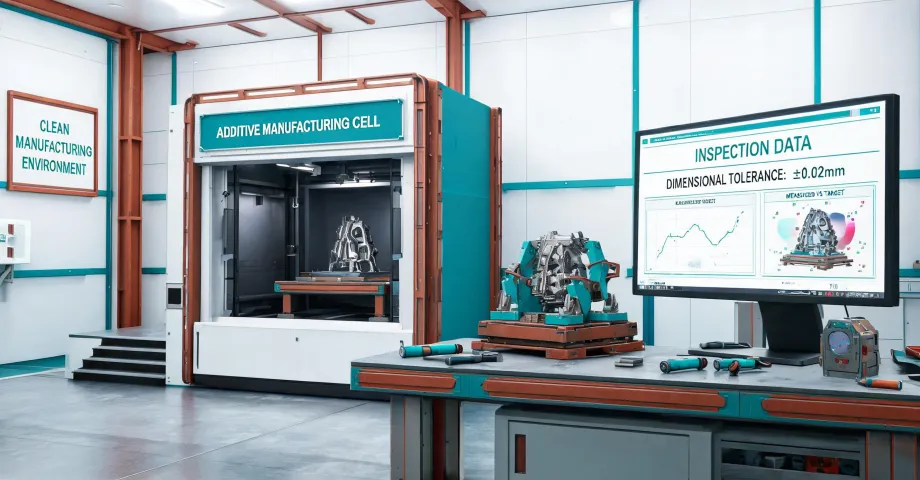
Industrial 3D printing is a different system entirely. We're talking about materials science, process calibration, and post-processing. A Markforged Metal X 3D printer, for example, is part of a workflow that includes washing, debinding, and sintering. That's not a desktop appliance. That's a small manufacturing cell.
The oversimplification — "it's just a printer" — causes buyers to compare machines the way they'd compare office equipment. And in that comparison, sticker price dominates. But with industrial 3D printing, the machine is maybe 40% of the total cost picture.
Procurement Culture Trains Us to Compare Unit Price
Second, and this one's on us in procurement: we're trained to compare unit prices. In my world, if two vendors bid $50,000 and $45,000 for the same spec, the answer is obvious. The spec guarantees equivalence.
That doesn't exist with 3D printers. No spec sheet tells you yield rate, print failure costs, operator time, or post-processing requirements. So we default to what we can compare: the sticker price. It's an honest mistake. It's also an expensive one.
People sometimes assume the gap between a $4,000 printer and a $150,000 system is mostly brand markup. From the numbers I've tracked, it's not. The gap is engineering, materials certification, and process control. Price follows performance, not the other way around.
The Market Is Maturing Faster Than Our Cost Models
Take the India ceramic additive manufacturing market. It's been growing steadily, driven by dental, medical, and electronics applications; multiple industry market analyses from 2024 projected continued double-digit growth through 2030. The applications are real. But when I've watched companies enter that market, many budget for the printer, the material, and a line item called "miscellaneous."
The actual cost structure includes powder handling, debinding furnaces, sintering cycles, and qualification runs. That's where the budget disappears. The same pattern shows up across metal and carbon fiber systems, whether you're in Detroit or Pune.
What This Costs in Practice
The "Cheap" Desktop Experiment
In 2023, we approved a $4,000 desktop 3D printer for engineering prototypes. The request was reasonable — we didn't want to tie up the industrial machine for quick design checks. The budget was $4,000 plus $500 for filament.
By the end of the year, that "cheap" printer had consumed:
- $2,300 in filament — we tried four brands before finding one that consistently met spec
- $1,800 in operator time for failed print cleanup and re-leveling
- $1,100 in post-processing tools, enclosures, and ventilation
- $1,700 in scrapped prototype iterations that would have printed fine on a calibrated industrial system
Total: roughly $6,900 beyond the initial purchase, on a $4,500 budget. I knew I should have run the full TCO before approving it. But I thought, "what are the odds a small printer becomes a money pit?" The odds were apparently 100%.
The End Mill for Brass Lesson
The same pattern showed up in traditional tooling. When we sourced end mills for brass machining, a supplier in China quoted us roughly half of what we were paying our existing vendor. I'm not going to name the supplier — the lesson isn't about them. It's about the math.
The China end mill quote looked good on paper:
- Unit price: ~50% of our current vendor
- Shipping: 3 weeks by sea, or 5x freight cost by air
- Tool life: 30% shorter, based on our machining logs
- Reject rate: 15% higher on brass batch runs
When we tracked cost per completed part over 60 days, the "cheap" end mills were 22% more expensive per part than the ones we'd been using. The sticker price was half. The real cost was higher.
The Fix: Compare Cost per Successful Part
After those two lessons, I built a cost model that our procurement team now uses for every equipment and tooling decision over $2,500. Here's the simplified version.
For any 3D printer candidate, calculate:
- Yield rate — what percentage of builds succeed on the first attempt? Hobbyist machines often sit at 60–80%. Industrial systems with proper preprocessing and process validation can hit 95%+ on qualified parts.
- Cost per build — material cost + machine amortization + operator time + post-processing (debinding, sintering, heat treatment, surface finishing).
- Failure cost — (cost per build) × (1 − yield rate), multiplied by your monthly production volume.
- Validation cost — if you're in aerospace, defense, or medical, part qualification has a real price. Certified platforms with documented material properties reduce that risk.
The output is your cost per successful part. That's the number to compare.
Most Markforged industrial 3D printer reviews focus on specs — tensile strength, print volume, materials supported, certifications. Those matter. But from a procurement perspective, the metric that matters most is the one reviews rarely include: cost per successful part at your volume. I'm not an applications engineer, so I can't speak to the metallurgy behind sintering cycles. What I can tell you from a cost perspective is that post-processing infrastructure is part of the capital decision, and it's often the part people forget.
What This Means for Your Decision
If you're making one-off novelty parts or weekend projects, buy the $299 printer and enjoy it. Nobody's TCO spreadsheet is going to beat that.
But if you're a manufacturer evaluating additive manufacturing — whether it's a carbon fiber system for jigs and fixtures, a Markforged Metal X 3D printer for production tooling, or a ceramic system for dental applications — the math is different.
Here's what I'd suggest: get quotes from at least three vendors, but don't compare the quotes. Compare your own spreadsheet. If a vendor quotes you 50% below list but can't produce yield rate data, model your budget around 70% yield. If they give you validated materials data and process documentation, model 95% yield. The spreadsheet will tell you which machine actually costs less.
This approach worked for us because we're a mid-size manufacturer with predictable build demand. If you're a job shop with wildly inconsistent volumes, the calculus might be different — short-run flexibility could justify a different machine altogether. Your mileage may vary.
To be fair, a full TCO model is overkill for a $5,000 lab printer used twice a month. But when the decision runs into six figures? Not doing the analysis is the riskier choice.
Bottom Line
"How much are 3D printers?" is the question everyone asks. It's also the question that produces the worst decisions.
After six years of tracking real numbers, I've stopped asking it. Instead, I ask vendors two things: what's your yield rate on qualified parts, and what does the complete workflow cost — machine, material, post-processing, and all? If a salesperson can't answer those, I'd be careful.
The cheapest machine on paper is rarely the cheapest machine in practice. And the machine with the highest list price isn't automatically the best value either. The only number that matters is cost per successful part. Run that calculation before you buy — you'll probably surprise yourself with how different the answer looks.