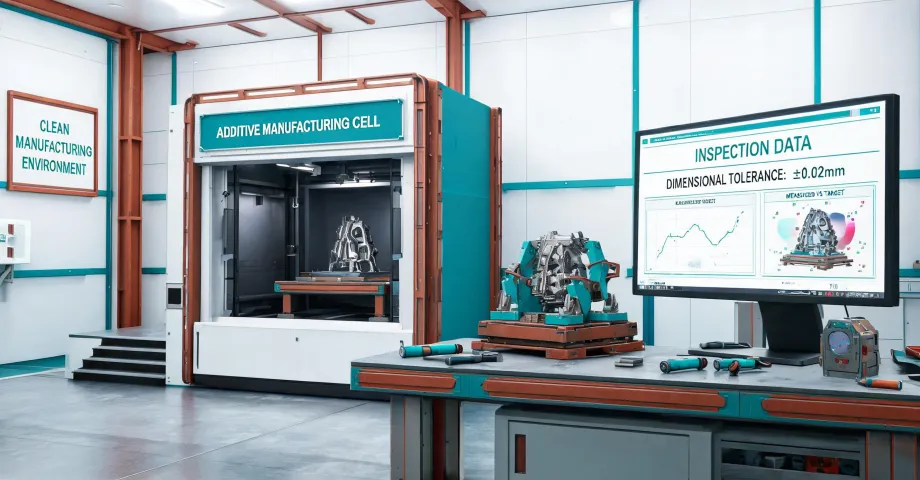
When I first looked up the Markforged FX20 3D printer price, I almost closed the tab.
I'm the quality and brand compliance manager at a manufacturing company. I review every part design and prototype before it reaches a customer—roughly 200 unique items a year, sometimes more. In 2024, I rejected about 8% of first deliveries for specification non-compliance. I've seen parts that were flawless, parts that were dangerously close to acceptable, and parts that made me wonder if anyone on the other end had ever held a caliper.
But that price tag made me flinch. I come from a CNC machining background, where I learned early that a $50,000 machine can be cheap if it runs reliably—and a $5,000 machine can be extremely expensive if it doesn't. Still, seeing the FX20's price range—I've seen quotes anywhere from $100,000 to over $200,000 depending on configuration—felt absurd next to a $6,000 Glowforge.
I went back and forth on this for two weeks. The budget options made perfect sense on a spreadsheet. The Markforged made sense in a way I couldn't yet prove. And I refuse to sign off on a purchase based on vibes.
So I did what I always do at work: I audited it. Not the machine. The total cost of the parts we actually needed to make. The numbers didn't just change my mind—they changed how I evaluate every equipment purchase from now on.
The Surface Problem: Why the Markforged FX20 Price Feels Absurd
The surface problem is obvious: Markforged 3D printer cost is high, and the alternatives are cheap. If you stop at the price tag, the conversation ends in ten seconds.
But the deeper problem is that most buyers compare machines without comparing the outcomes they produce. That's not a budgeting problem. That's a quality problem.
Let me give you an example from my background. Anyone with CNC machining experience knows you don't reach for an HSS end mill on stainless steel if you want the job done right. HSS tooling costs roughly half of what carbide costs. On paper, it's the budget move. But on stainless, an HSS end mill wears down fast, loads up, and leaves a surface finish that can fail inspection entirely. By the end of the job, you've spent more on tool replacements and wasted material than the carbide tool would have cost from the start.
What I mean is: nobody actually saves money by buying the cheap tool. They just move the cost somewhere less visible—into rework, scrap, inspection hours, and delayed deliveries. And by that I mean the real invoice shows up in the quality report, not the purchase order.
The same logic applies to the Markforged decision. When you compare a machine built for repeatable, traceable, production-grade parts against a desktop printer or a hobby laser cutter, the price gap is real. But it's only the beginning of the calculation.
What the Markforged 3D Printer Cost Doesn't Tell You
Here's where I landed after breaking down the total cost for a production run we quoted in early 2024.
We had three paths. First, use the existing CNC equipment in our facility—machining was the familiar route, but the part geometry was awkward and would have required complex fixturing. Second, buy a budget desktop additive system for "prototyping" and hope it could handle real production. Third, bring in a Markforged industrial system and make the parts the right way.
Our spreadsheet pointed to path two. It was the classic cheap-additive story: lower upfront cost, flexible geometry, no fixturing. But when I looked at the fine print, the rejection rate projections were suspiciously optimistic, the layer adhesion was inconsistent across samples, and every single part would need individual inspection before I could put my name on it.
That's the hidden cost. In my experience auditing vendor performance for the past four years, the cheapest option has cost us more in at least half the cases. It almost never shows up as one big number. Instead, it leaks out in these ways:
- Setup and calibration waste. Every failed print burns material and machine time before you get a single good part. On a cheap machine, that "calibration phase" never really ends.
- Inspection burden. An inconsistent machine means every part is a suspect. That's extra hours on my bench, and my hours are a cost too.
- Rework and scrap. A bad part isn't just a bad part. It's a delayed delivery to a customer who will never know or care how much money you saved on the machine.
- Field failure risk. When a part fails at a customer site, you don't lose the part. You lose the trust. And trust is the one thing no budget can restore quickly.
The cost analysis said the budget option was 35–40% cheaper on paper. My gut said the failure assumptions baked into that analysis were too optimistic. I went with my gut—which was awkward, because in a budget meeting, "my gut" is a lot harder to defend than a spreadsheet.
Turns out the spreadsheets were wrong. The Markforged route cost more on day one but produced consistent, traceable parts with predictable quality. That's exactly what my sign-off depends on, and exactly what the budget option couldn't offer.
The $22,000 Lesson
If that sounds theoretical, here's a story from our own audit history.
In 2022, we received a batch of 8,000 units from a supplier where a critical specification was visibly off. I'm not talking marginal drift—I'm talking "anyone with a caliper and two eyes can see it" off. The spec deviation was roughly three times our documented tolerance. The vendor claimed it was "within industry standard."
We rejected the batch anyway. The rework cost $22,000 and pushed our product launch back two weeks. The vendor ended up covering the redo at their cost, so on paper, we came out even. But nobody reimbursed us for the delay. Nobody reimbursed us for the internal man-hours spent quarantining, inspecting, and coordinating. And our customer certainly didn't extend us more patience the next time there was an issue.
People quoted us a $500 fix that would have prevented the whole thing. Nobody talks about the $500. They talk about the $22,000. That asymmetry—between the small prevention cost and the large failure cost—is what I think about every time I review a machine purchase.
The Framework I Use Before Approving Anything
Let me be clear: I'm not saying every shop needs an FX20. That would be lazy thinking. But I am saying that "what does a Markforged 3D printer cost?" is the wrong first question.
Ask these instead:
- What does the part actually need to be? Load-bearing? Certified? Traceable? Tolerance-critical? Define the requirement before you define the machine. If the part is a one-off prototype, a $6,000 Glowforge or a hobby printer might be all you need. If it's a production component with structural requirements, the category changes.
- What does one good part really cost? Track material waste, rejection probability, inspection hours, and rework risk. The machine's sticker price is not the cost. The cost is what a successfully delivered part eats out of your budget.
- What does a failure cost? Not just the scrap—delays, field failures, customer confidence. If failure is expensive, then reliability is a form of savings that simply doesn't show up on the quote.
- What category of tool do you need? The learning curve for how to use a Glowforge laser cutter is genuinely shallow, and for sheet materials it's a great choice. Desktop CNCs and hobby printers have their place too. But those tools are not in the same category as an industrial additive system, and pretending they're interchangeable is how you end up with a quality incident and a $22,000 surprise.
I used to jump straight to price comparisons. Now I don't. I map the part requirements first, and then I let the category of the machine follow. It's a small mental shift, but it changes everything.
The Takeaway: Sticker Price Is the Smallest Number
I'm not 100% sure about current FX20 pricing—quotes vary by configuration and region, and Markforged adjusts its lineup over time. Don't hold me to the exact numbers. But what I trust more than any quote is the pattern in our own quality data.
Since we started evaluating equipment this way, our rework rate has dropped, our on-time delivery has improved, and I've stopped having those "remember the $22,000 batch?" conversations. Quality, price, lead time. Pick two, and if you pick price and lead time, quality will find a way to bill you later.
In my opinion, buying manufacturing equipment is a quality decision, not a shopping decision. You can buy a machine with a visible price tag, or you can buy a problem with invisible costs. After four years of signing off on both, I'd rather defend the visible price every single time.
If you ask me, that's the real math.