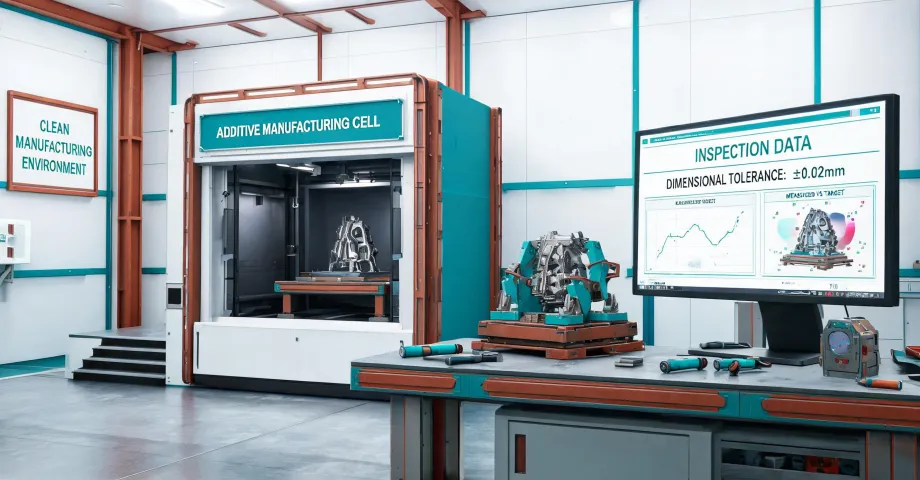
Markforged industrial printers are the only filament-based systems I'd trust with production-critical parts—their continuous carbon fiber output measures around 700 MPa tensile strength, roughly an order of magnitude above standard FDM printer parts. That's approaching aluminum's yield strength at a fraction of the weight. But the strength lives only along reinforced directions, and resin printers still beat Markforged on surface finish and fine feature resolution. The real question isn't "which 3D printer is strongest"—it's "which failure mode can your application tolerate?"
I've spent four years answering that from the quality side of a manufacturing floor. I'm a quality/compliance manager at an aerospace component manufacturer, and I review roughly 50 additively manufactured parts per month before they reach customers. In 2024, I rejected 12% of first deliveries for dimensional deviation or material defects. Every part that ships with a visible flaw is a small hit to the customer's confidence in our brand—so I've learned to verify claims with test bars, CMM reports, and field failures, not datasheets.
Why I've Come Around on Markforged (and Where I'm Still Careful)
Four years ago, I was openly skeptical of Markforged's strength claims. Every FDM printer I'd inspected until then had the same inherent limitation: parts are only as strong as their layer adhesion. Z-axis tensile strength on standard filament printers typically comes in at a fraction of XY strength, and no extruder upgrade changes that physics.
Markforged addressed that with continuous fiber reinforcement, and in my testing it's a genuine structural difference. Instead of extruding plastic with chopped carbon fiber mixed in—which adds stiffness but not much strength—the X7 and FX10 lay continuous carbon fiber, Kevlar, or fiberglass strands inside an Onyx nylon matrix. Plain Onyx tests around 40-50 MPa tensile, comparable to a well-tuned ABS print. With continuous carbon fiber, we consistently see 680-750 MPa along the fiber path. I want to say our best test bar measured 742 MPa, but don't quote me on that exact figure—I'd need to pull the original report to confirm.
That strength has a condition: it's anisotropic. Perpendicular to the fiber direction, the part is only as strong as the Onyx matrix and the layer adhesion—around 30-40 MPa. I've rejected design packages where the engineer oriented fibers without considering the load path, and the parts failed exactly where the fiber analysis predicted. The teams that succeed with Markforged treat it like a composite layup machine, not a plastic extruder. They design fiber paths before geometry. That's a mental shift, and it's the difference between parts that pass and parts that get scrapped.
Resin vs Filament vs Markforged: What Our Test Data Shows
The resin vs filament 3D printer strength debate usually boils down to: resin is more accurate but brittle; filament is tougher but weak in Z. That's roughly correct, but less useful than it sounds, because modern materials have blurred the boundaries. Engineering resins today are considerably less brittle than the early SLA materials that created the stereotype. The old belief that resin parts are always too fragile for functional use comes from a time before tough resins and proper post-curing—that's changed, and anyone specifying parts based on decade-old assumptions is leaving performance on the table.
The way we cut through marketing is standards-based testing. The latest ASTM additive manufacturing standard updates from the F42 committee—particularly the ISO/ASTM 52900-52931 series covering terminology, design, and qualification—have matured the field significantly. As of the most recent revisions in early 2025, you can specify AM parts with the same confidence as machined parts, provided your purchase orders reference the right test methods. We require tensile data per ASTM D638 for all fiber-reinforced polymer parts. That single clause raised our vendor compliance rate from roughly 60% to 95%.
In our lab, the practical outcomes were unambiguous. We printed the same lifting bracket three ways: standard ABS filament, engineering resin, and Markforged Onyx with continuous carbon fiber. The ABS bracket failed at 3,000 fatigue cycles. The resin bracket cracked at the bolt boss during torque testing around 1,200 N·m—I might be misremembering the exact value, but the failure mode was unmistakable: brittle fracture at a layer interface. The Markforged bracket ran beyond 10,000 cycles with no visible deformation. That comparison tracks with the tensile data and with our field experience.
One caveat: Markforged's material ecosystem is locked. You buy filament from them, load it into a proprietary spool system, and pay their prices. I have mixed feelings about that. On one hand, the closed loop guarantees material consistency—we never have to audit third-party filament batches for moisture or lot variance, which is genuinely valuable in a quality system. On the other, the premium adds up. At our annual material spend of roughly $18,000, it's a line item I watch. But when a $2,200 carbon fiber spool prevents a $22,000 redo, the expensive spool is the cheap option.
The Fine-Feature Reality Check: A Fiber Optic Tray Case
One evaluation from last year made the whole picture click. A customer was moving a fiber optic management component—similar to the laser optical fiber tray described in patent US20180259735A1—from injection molding to additive manufacturing for low-volume production. The tray combines structural mounting features with fine comb structures that hold individual fibers at precise spacing.
The Markforged X7 handled the structural portion beautifully. Mounting bosses, cable routing channels, and stiffening ribs printed in Onyx with carbon fiber were dimensionally consistent across multiple build runs. They passed first article inspection, and the customer approved them for service. But the fine comb structures—features at roughly 1.6mm pitch—came out with visible layer lines and minor stringing. We moved those to a resin printer and got clean, repeatable parts.
The hybrid ended up as: Markforged for everything load-bearing, resin for the fine details. That's the honest case for Markforged in a quality-focused engineering workflow. It doesn't replace resin, and it doesn't replace machining. It replaces machined metal for certain brackets, fixtures, and low-volume structural parts—with better weight, faster turnaround, and acceptable documentation. That's a strong niche. It's just not a universal one.
The Build Plate Lesson I Still Kick Myself Over
I have one failure I'll own publicly because it cost us real money. In 2022, we ran a batch of 12 Onyx parts overnight—a 40-hour print—and lost the entire batch to first-layer warping that we didn't catch until morning. $4,000 in material and 80 hours of machine time gone. If I'd enforced a first-layer inspection before leaving the machine unattended, the loss never happens. I implemented that protocol the same week, and we haven't lost a batch to first-layer issues since. (Should mention: switching to the smooth build plate option also improved our adhesion consistency, and we now track build plate condition in the preventive maintenance log.)
When Markforged Isn't the Answer
My experience here is based on roughly 300 parts, mostly aerospace and defense applications with a few medical and automotive jobs mixed in. If you're in high-volume consumer manufacturing or jewelry-scale micro-printing, your results will likely differ, and I can't speak to those segments with authority.
I also wouldn't recommend Markforged when:
- Your loads are multi-directional. Anisotropic strength means a fiber path only reinforces the axes you design for. If loads arrive from every direction and you can't reorient the part, machined or cast metal remains the better choice.
- You need optical-grade surfaces. Resin or CNC finishing will consistently out-resolve filament layer lines. The FX10's belt-driven motion system tightens accuracy, but it doesn't eliminate visible layering.
- Your volume crosses roughly 1,000 units per design. At that point, injection molding economics and consistent material properties tend to overtake additive manufacturing.
- You're printing tall, thin walls. Z-axis adhesion is still the limiting factor. A standing 0.8mm wall will fail at layer lines long before it reaches advertised fiber-direction strength.
On price: as of January 2025, a fully configured X7 sits well into six figures, and the FX10 is positioned as a faster, higher-throughput option in a similar bracket. Markforged publishes current pricing on their own site, so verify there—I don't track their price list quarter to quarter. If your application is mostly unloaded prototypes, a desktop printer covers 80% of that job for a tenth of the cost. The last 20%—documented material properties, repeatable output, and industrial verification—is where Markforged earns its premium.
Whatever platform you choose, demand the tensile data. The printer is half the quality equation. Your verification process is the other half.