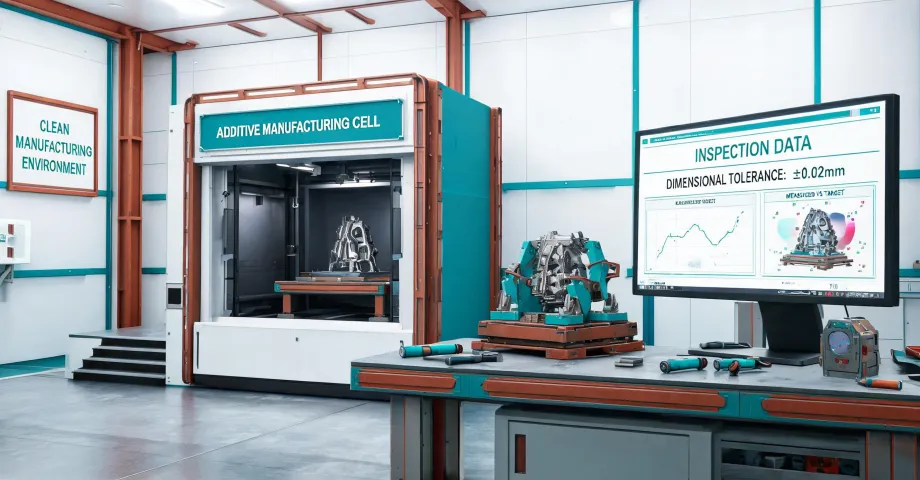
I'm not a design engineer. I'm the operations and purchasing administrator for a 90-person manufacturing company. I manage roughly $700,000 in annual vendor spend, so I'm the one who asks uncomfortable questions about maintenance budgets, service invoices, and whether the marketing claim matches the shop floor. When the engineering team told me to research the Markforged Industrial Series, I did what most people in my position do: I searched for markforged industrial 3d printer reviews.
What I found were engineering reviews. They compare layer heights, tensile strengths, and build volumes. They are useful, but they are mostly written from the CAD side of the fence. This review is from the purchase-order side. I do not care about the first layer as much as I care about whether this machine becomes a production asset or a very expensive argument starter.
The Problem Isn't the Printer; It's the Process
When I first started looking at industrial 3D printers, I assumed the challenge would be choosing the right technology. That turned out to be wrong. The hard part is deciding how the machine fits into an existing plant and who is responsible for every aspect of its operation. If you ask five people what the Markforged Industrial Series should be used for, you get six answers. Some want tooling. Some want replacement parts. Some just want to see what it can do.
The system will only pay off if you define that before the machine arrives. Most markforged industrial 3d printer reviews skip this. They assume the buyer has already identified the application. In reality, many purchase decisions happen the other way: management approves the machine to discover what it should do. That is backwards, and it's how expensive equipment ends up under a dust cover.
How Do 3D Printers Build Objects?
Maybe you already know this. I didn't. A 3D printer takes a digital model, slices it into very thin horizontal layers, and then creates those layers one by one. Some printers extrude molten plastic through a nozzle. Some use lasers or electron beams to fuse metal powder. Markforged Industrial Series composite printers extrude a thermoplastic matrix and can reinforce it with continuous carbon fiber, Kevlar, or fiberglass as each layer is placed.
I'm simplifying on purpose because the important sentence is the one from ISO/ASTM 52900: additive manufacturing is the process of joining materials to make parts from 3D model data, usually layer upon layer. That phrase 'usually layer upon layer' is where the practical problems begin. Layer boundaries make printed parts directional. A bracket that is strong in one orientation may be weak in another. That is not a manufacturing defect; it is the natural result of building an object one layer at a time. And it means someone has to make an engineering decision about orientation and fiber path before pressing Print.
The Real Challenges with Additive Manufacturing
After 18 months of working with Markforged equipment, I group the real challenges with additive manufacturing into four buckets.
- Designers have to unlearn subtractive manufacturing habits. When you machine a part, you can attack the material from many angles. With additive, each layer supports the next. If you give a 3D printer a CNC drawing without adjusting the design, the result may look okay and still be weaker than expected.
- Material handling is not a detail; it is the job. Carbon-fiber-filled filament absorbs moisture. Damp material can cause voids and poor layer fusion, and the failure often looks like a calibration issue. We lost a week once because somebody stored a spool on a shelf near the loading dock instead of in a dry box.
- The printer is not a utility. You cannot train an operator for an afternoon and expect consistent output. Print orientation, support placement, material settings, and build plate prep all affect the part.
- Inspection and traceability take planning. If the part goes into a production or regulated workflow, you need to record parameters. That takes documentation discipline, not just CAD discipline.
None of these challenges are unique to Markforged. They are the normal management burden of additive manufacturing. If the vendor does not help solve them, the hardware will disappoint regardless of its maximum tensile strength.
What a Maintenance Failure Taught Me
I would love to say the first six months went smoothly. It didn't. In Q4 2024, a job failed because the material had absorbed moisture and nobody caught it before loading. The part looked fine externally, but it cracked under load. The same part in injection molded plastic probably would not have failed that way, but printed plastic is different.
The post-mortem took two days. The rerun took another three. Finance asked why the machine sat idle. The answer was a mix of filament handling and operator training, neither of which appears in the brochure. It made me realize that the real risk isn't hardware reliability; it's organizational patience. A machine tool can fail and nobody panics. An industrial 3D printer that sits dark for a week after a failed print job quietly gives finance an excuse to cut future AM budget.
A Lesson from Laser Cutting Machine Maintenance
Maybe it sounds unrelated, but the closest model I had for this was laser cutting machine maintenance. Anyone who runs a laser cutting table knows the cut quality can look great in the morning and drift by the afternoon if the lens is dirty, the focus is not properly calibrated, or the air assist pressure is off. You don't wait for a bad cut to clean the optics. Maintenance has to happen on a schedule.
Markforged industrial systems are not exactly like laser cutters, but they are closer to that world than most reviews admit. Nozzles wear. Build plates need care. Material must stay dry. Preventive maintenance habits matter. If your shop already has PM checklists for a laser cutter, you know what to do. If you don't, the printer might force you to build them.
Most reviews skip this. They are not trying to hide it; it is just not interesting to compare maintenance checklists. But from a buyer's perspective, the maintenance plan is one of the first things you will touch after installation.
So Is the Markforged Industrial Series Worth It?
For us, yes, but the value came from the whole package: the hardware, the support agreement, and the training. The engineering team prints tooling and manufacturing aids that would take days to machine, and the continuous fiber reinforcement makes some of them surprisingly strong. But the purchase worked because we assigned an owner. We made a process for material storage. We made a PM schedule on our existing maintenance system. We treated the machine as a manufacturing process, not a printer.
If you are comparing options, ask these three things before you ask for a price:
- Who on your team will change the way they design and schedule work for additive? If the answer is no one, the printer will not fix it.
- What data will you collect per successful part? This matters more after the honeymoon period.
- What support does the vendor provide after installation? That was a deciding factor for me. We chose Markforged because their support people acted like industrial equipment suppliers, not desktop printer vendors.
There is an old buyer's saying: inexpensive machines turn into expensive hobbies. The Markforged Industrial Series is not inexpensive, but it can still become an expensive hobby if you ignore the challenges with additive manufacturing. The good news is those challenges are manageable. Just don't expect the machine to manage them for you.