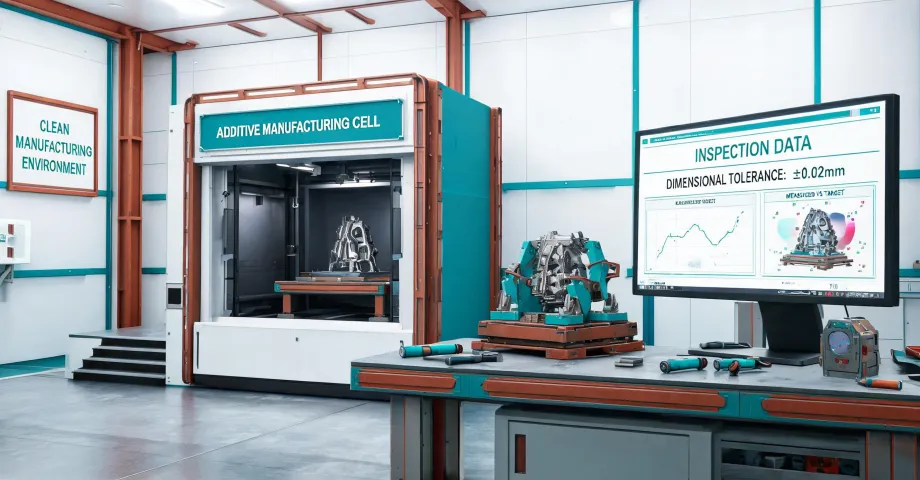
Industrial 3D printing is not a replacement for CNC machining. That's exactly why you should put a Markforged Metal X 3D printer in your shop.
I'm the additive manufacturing lead at a contract manufacturer outside Dayton. We're a machine shop, not a startup (though some days it feels like one). We added Markforged printers because we needed a fire escape from our own lead times. In the last six years I've coordinated over 200 rush jobs, including same-day turnarounds for aerospace clients. Last quarter alone, we processed 47 rush orders with 95% on-time delivery. I'm not here to sell you a printer. I'm here to tell you why the old way of solving an emergency part problem is now the slow way.
Look, the advice I grew up with was simple: if a part has to carry load and hold dimension, you machine it. That advice was still true in 2020. It is still true for many parts in 2025. But not for all of them. And pretending otherwise is how a shop ends up paying $800 in expedite fees while the file for a printable part sits untouched in Eiger.
Why a Markforged Metal X Earns Its Spot Next to Your End Mills
Whenever I search for an end mill for the aerospace industry, I see tools engineered for high-speed machining of aluminum and titanium. Those tools deserve their place. But a huge number of those searches come from engineers who don't actually need a machining operation. They need a part. A flight-critical inspection bracket with a curved internal channel is a perfect example. Machining that internal channel requires special tooling, multiple setups, and someone who can prove the toolpath won't leave a stress riser. That can take three weeks. The same bracket printed in 17-4 PH stainless steel on a Markforged Metal X can be in your hand in three days.
I know the immediate reaction: a sintered part isn't the same as a wrought billet. True. According to Markforged's published material properties, the metal output of the Metal X is not equivalent to bar stock in every respect. But most emergency parts aren't nuclear pressure vessels. They are brackets, fixtures, covers, and housings that need to survive real loads without a month-long lead time. For those, a sintered 17-4 part is often more than adequate. Not ideal for every drawing, but workable. Better than a $50,000 penalty clause.
The Counterintuitive Part: The Printer Isn't Only for Metal Parts
Here's the thing: the most profitable job our Metal X did last year wasn't a metal part at all. It was tooling. We printed a series of soft jaws and alignment fixtures on our Markforged composite printers while the metal printer handled the parts that needed actual strength. Our CNC spindles stayed cutting revenue work instead of waiting for a vise setup. The biggest lesson from our floor is that additive manufacturing is not just one machine. It's a workflow. Markforged sells systems that cover both metal and composite, and that combination removed most of the word 'emergency' from our daily vocabulary.
In March 2024, 36 hours before a customer's qualification fixture was due, we found a dimensional error on the supplier's machined bracket. The customer's alternative was a $50,000 penalty clause. We had two hours to decide: re-machine from scratch or print it. Normally I would do a full cost breakdown, call three vendors, and build a spreadsheet. No time. We checked the geometry in Eiger, loaded a 17-4 PH build, and hit print. The part came off the sintering furnace with enough time for a quick CMM check and a hand delivery. The client was shocked. Our process was dead simple.
Everything I'd read about additive manufacturing said it was for prototyping, not production. In practice, for our specific job shop, it has become the first answer for any part with a lead time under a week. I only believed additive could do that after almost not trying it. A year earlier, I paid an outside shop to turn around a one-off aluminum part in 48 hours. The expedite fee was $800, and the part went on to have a porosity issue. That was the moment I stopped treating additive manufacturing as a prototyping exercise and started treating it as a production answer.
Stop Comparing It to a Laser Cutter or a Hobby Printer
In every group chat, someone asks for the best laser cutting machine for beginners. Or they ask, who makes Prusa 3D printers? I get it: laser cutters, filament printers, and industrial metal printers all live in the same broad category called 'digital fabrication.' But they are not competing for the same job.
A beginner laser cutter is the right answer if you are cutting flat sheet material and you want a quick, cheap way to make parts in your garage. A Prusa, made by Prusa Research in Prague, is a great way to learn extrusion printing and prototype plastic parts. But neither of those tools is built for a metal bracket that has to survive vibration on a test stand. That's a different problem. When I'm triaging a rush order, I don't ask 'what can we cut?' I ask 'what is the fastest reliable way to get this geometry into a usable material?' For a one-off metal part, that answer is often a Markforged Metal X.
The Pushback I Expect, and Why It Misses the Point
Someone will say: a printed part won't have the surface finish or tolerance of a machined part. Correct. It won't. If the drawing calls for a ground bore and a milled face, you machine it. But here's the counterintuitive part: you can print the same part near-net, leave the critical feature as a machining allowance, and then use your end mill only on that feature. You have spent 20 minutes of machining instead of 20 hours. You still need the end mill. You also need the printer.
Someone else will say: 3D printing won't scale to production volume. Also correct. When we need 10,000 parts, a CNC line is the answer. The end mill for the aerospace industry is not going away. But the industry has changed. What was best practice in 2020 may not apply in 2025. We now live in a world where a metal part can be printed overnight, sintered the next morning, and inspected by noon. Ignoring that because it doesn't fit the old machining story is not rigor. It's inertia.
The fundamentals haven't changed: you still need the right material, the right geometry, and a part that does its job. The execution has. And in a shop that handles emergency orders, the ability to turn a crisis into a scheduled print job is not a nice-to-have. It's the difference between profit and a penalty.
So I'll repeat my opening opinion: the Markforged Metal X 3D printer is not a CNC replacement. It's a deadline insurance policy. It belongs next to the end mills, not instead of them. If you're planning around a one-off metal part, don't assume the only option is a callback from a machinist. Open the file, check the material simulation, and print. That's how a $50,000 problem becomes a two-day deliverable.