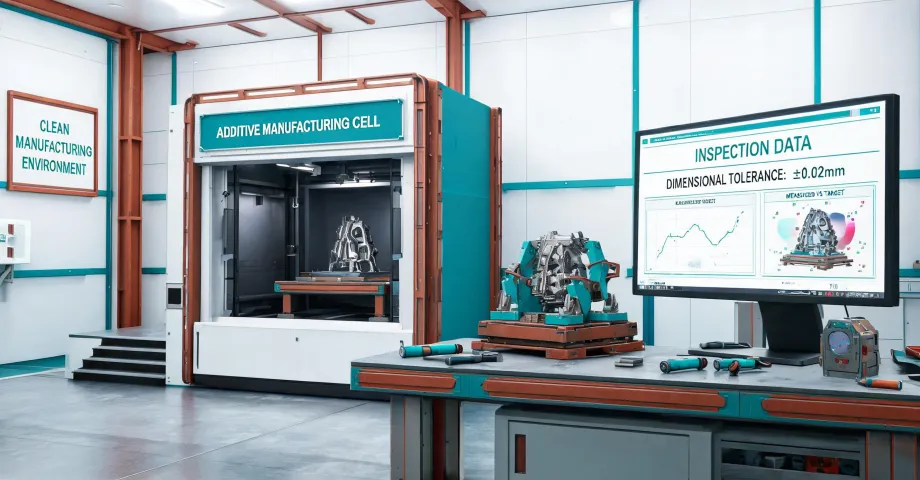
If you're evaluating a Markforged 3D printer for a manufacturing operation, here's the answer up front: the Markforged Onyx Pro is worth the investment for production parts—but the printer itself is only half the purchase. We cut our custom fixture turnaround from three weeks to two days, and the ROI came from rethinking our workflow around the printer, not from the hardware alone.
I manage equipment purchasing for a 200-person manufacturing company. Roughly $600,000 in annual spending, eight vendors, and one very opinionated finance department. When I took over buying in 2020, I didn't know a 3D printer from a coffee maker. Five years and two major equipment cycles later, the Markforged Onyx Pro taught me the most about how industrial buying actually works—and not for the reasons I expected.
Here's what I wish someone had told me before we wrote the check.
What You're Actually Buying With a Markforged 3D Printer
The first thing to understand: you're not buying a printer. You're buying a material ecosystem. The Onyx Pro's value is in composite materials—Onyx (chopped carbon fiber nylon) and continuous carbon fiber reinforcement. The printer is just the platform that delivers that material science.
From the outside, it looks like any other industrial printer. The reality is that the materials are where the capability lives. We're printing fixtures and end-of-arm tooling that have genuinely replaced aluminum parts in some cases. The continuous carbon fiber gives those parts real structural strength—not "plastic piece" durability, but actual production tooling.
One reason we chose the Onyx Pro over other Markforged models: it sits in the sweet spot between the desktop-grade units and the high-end production platforms. It gives us industrial-grade composites without the capital expense of a full production system. For a mid-size shop like ours, that positioning made sense.
How our evaluation actually worked
We spent about six weeks evaluating industrial 3D printers before settling on Markforged. Three questions drove the decision:
- Can it produce parts that survive on a real shop floor, not just an office?
- Can our engineers learn the software without a two-week training course?
- Does the vendor have credibility with auditors? We do defense contract work, so certification paths matter.
The Onyx Pro won the first two points decisively, and it didn't embarrass us on the third. Aerospace and defense credibility is a real differentiator when your customers audit your equipment list.
We did not buy the cheapest option, and that was deliberate. A few years earlier, I chased a low quote on carbide end mills from a new vendor and saved $1,800 on paper. Then the invoice arrived handwritten, finance rejected the expense, and I ate the cost out of my departmental budget. Now I verify a vendor's systems before I verify their prices.
Where the Efficiency Wins Showed Up
Here's the part finance actually cares about: our custom fixture lead time dropped from two-to-three weeks to one-to-two days. That's a 90% reduction. When a production line is waiting on a fixture, every day of downtime is money. This one number justified the entire purchase.
What I didn't expect was the mindset shift. Our engineers don't batch requests for off-site machining anymore. They iterate on a fixture design in the morning and have a working part by the afternoon. The iteration cycle went from weeks to hours, and that changed how they solve problems. It's the efficiency flywheel you hear talked about in theory—we actually saw it happen.
We also print drill guides, assembly aids, and inspection gauges. One engineer's printed tool has been in daily service for eight months with zero issues. That changed how the shop floor views "printed" parts.
What I Didn't Expect: The Real Cost Structure
Here's the counterintuitive part: the printer was the cheapest piece of the system. By the time we finished setup, we'd spent roughly twice the printer's price on the initial material package, software licenses, and installation. The materials are genuinely superior to commodity thermoplastics, so I'm not complaining. But that number never showed up in the marketing materials.
And there's a halo of related tooling costs. Printed composite parts often need secondary machining, and carbon fiber is abrasive. We order carbide end mills for hardened steel tooling, and we learned they're also the right choice for cutting printed composites. Standard HSS tools wear out quickly on carbon fiber, so the tooling upgrade wasn't optional—it was necessary.
This pattern repeats across every equipment category I've purchased. When we bought an auto body laser welder for the repair side of our business, the unit price was again the smallest line item on the invoice. Extraction, training, shielding gas, and consumables dwarfed the machine cost. The equipment buyers who budget only the sticker price are the ones who get burned.
Where Markforged Does Not Fit
Now the honest boundaries. There's a lot of advice out there treating 3D printing as a universal solution. It isn't.
Markforged is not a kids' printer. If your search history includes "what is the best 3d printer for kids," the Onyx Pro is the wrong answer. It's industrial equipment with industrial pricing, and it needs committed operators. Kids' printers are a completely different category, at a fraction of the cost. I know because I've bought those too—for my own kids, on my own budget.
It also can't replace traditional machining. We still outsource high-volume parts, tight-tolerance components, and certain geometries to CNC shops. The Onyx Pro complements our capabilities; it doesn't replace them. Anyone claiming industrial 3D printing completely replaces machining is selling something.
The material economics only favor printing when you're making functional parts. Onyx and carbon fiber filament cost meaningfully more than commodity PLA or ABS. For display prototypes and concept models, a cheaper machine is the right answer. We're selective about what we print at that material cost.
One more confession from the admin side: looking back, I should have pushed harder for a comprehensive service contract during negotiation. The standard warranty seemed sufficient at the time because I assumed the printer would either work or not. The real downtime sources—material loading, nozzle changes, bed calibration—are exactly what a service plan handles more cleanly than in-house troubleshooting. I do not make that mistake on new equipment anymore.
Pricing, as of Q1 2025: the Markforged Onyx Pro runs about $7,000 for the printer alone. Budget two to three times that for a complete working system. Verify current rates at markforged.com because this market changes quickly. I learned that lesson the hard way when material prices shifted between our quote and our purchase order.
If I could redo the decision, I'd spend more time upfront specifying exactly which parts and materials we'd need. But given what I knew then—that we needed a faster path to custom fixtures—the Onyx Pro was the right call. It's our most-used piece of fabrication equipment, and the shop floor would genuinely stage a mutiny if I took it away.
I'm not an engineer, and I won't pretend to be one. What I can offer is the purchasing perspective: evaluate the workflow, the total cost, and the boundaries before you buy. If you're researching a Markforged 3D printer for your own operation, don't just compare hardware specs. Compare the complete system—including everything the brochure doesn't mention. That's where the real answer lives.