I've been handling manufacturing orders for aerospace and automotive clients since 2019. In my first year, I made the classic mistake: assumed that because a technology was 'advanced,' it automatically made financial sense. I ordered 200 brackets printed on a Markforged Onyx Pro because the lead time was shorter than CNC. The parts worked fine. But the cost per unit was 3.2x what traditional machining would have charged. That $640 premium taught me a lesson I still apply today: the right process depends on volume, geometry, and material requirements—not just novelty.
This article compares Markforged industrial 3D printing (specifically the Onyx, FX10, and Metal X series) against traditional manufacturing methods (CNC milling, laser cutting, and injection molding). The goal is simple: help you decide which approach fits your specific project—without the hype or the fear of missing out.
My experience is based on about 150 orders across 4 manufacturing shops. I've personally made maybe $8,000 in avoidable mistakes. If you're working with large-scale production runs (10,000+ units) or specialized materials like Inconel, your experience might differ significantly.
Cost Per Part: The Volume Equation
The popular narrative says 3D printing is cheaper for small runs. That's true—but the margin of savings is narrower than most vendors advertise.
Traditional machining (CNC, laser cutting): Setup costs are high ($150–$500 per program), but per-unit costs drop dramatically after 10–20 units. For a typical aluminum bracket, CNC costs around $12–18 per unit for quantities of 100+.
Markforged 3D printing (Onyx or carbon fiber): Zero setup cost (no tooling, no CAM programming), but per-unit costs are flat. For that same bracket printed in Onyx, the material cost is approximately $8–15 per unit regardless of quantity. At 50 units, that's competitive. At 500 units, CNC will be significantly cheaper.
Why does this matter? Because I've seen buyers order 200+ parts on a Markforged system because they liked the material properties—and ended up paying 40% more than CNC. The break-even point is usually around 30–50 units for simple geometries, and 15–25 units for complex parts that require 5-axis CNC work.
Pricing is for general reference only. Actual rates vary by vendor, material, and lead time. Verify current quotes before committing—especially for rush orders.
Lead Time: Speed vs Certainty
This is where Markforged shines—but the buyer's reality is more nuanced than marketing suggests.
Markforged 3D printers can produce a functional part in 24–72 hours, assuming the printer is available and the material is in stock. For prototyping or emergency replacements, that's unmatched. According to Markforged's published specs, the FX10 can print carbon fiber parts up to 10x faster than composite layup methods—which is a real advantage for aerospace pre-production.
Traditional machining: CNC shops typically quote 5–10 business days for standard work. Laser cutting is faster (3–5 days), and waterjet can be same-day for simple geometries. But all of these depend on material availability and machine scheduling.
Here's the catch I've learned the hard way: Speed is not the same as certainty. I've had a Markforged print fail at hour 22 of a 24-hour job because of a layer adhesion issue. That cost me 22 hours plus a reprint. With CNC, the machine either works or it doesn't—but failures are rare, and rework is usually faster than a full reprint.
For rush orders (need it tomorrow): 3D printing wins, assuming you have the file ready and the printer is free. For planned production with a fixed deadline, CNC's reliability often offsets its longer lead time.
Material Properties: Strength vs Predictability
Markforged's key advantage is its continuous carbon fiber reinforcement. The Onyx material (nylon with chopped carbon fiber) has a tensile strength around 40 MPa. With continuous fiber reinforcement, that jumps to 800+ MPa—comparable to some aluminum alloys.
But here's the catch that vendors don't always highlight: 3D printed parts have anisotropic properties. The strength varies depending on print orientation. A part printed flat may be 30% stronger than one printed vertically. For critical aerospace or medical components, this variation matters—and it requires careful validation.
Traditional materials (6061 aluminum, steel, acetal) have predictable, isotropic properties. A machined block of 6061-T6 has consistent tensile strength regardless of orientation. For load-bearing or safety-critical parts, this predictability is often worth the higher per-unit cost.
When material properties drive the decision:
- Choose Markforged carbon fiber when: weight reduction is critical (20-30% lighter than aluminum), complex geometries require internal channels, or you need corrosion resistance without coating
- Choose CNC machining when: the part will face cyclic loading, requires tight tolerances (below ±0.1mm), or must meet aerospace/medical certification standards
Complexity and Design Freedom
This is the dimension where the comparison flips—and may surprise some readers.
Conventional wisdom says 3D printing wins for complex geometries. That's true for internal features (conformal cooling channels, lattice structures). But in practice, for most B2B manufacturing orders, the complexity advantage is smaller than expected.
Here's why: modern 5-axis CNC machines and multi-tool lathes can produce remarkably complex parts. A well-designed part with proper draft angles and coordinated tool paths can match 3D printing's geometric freedom for 80-90% of applications. The remaining 10%—undercuts, internal passages, organic shapes—are where Markforged truly excels.
The mistake I made in early 2022: I designed a bracket with an internal cooling channel specifically for 3D printing, assuming CNC couldn't do it. A machinist friend pointed out that a drilled and plugged channel would have worked just as well—at half the cost. The design freedom of 3D printing is real, but it's often a solution in search of a problem.
Quality and Consistency
For industrial production, consistency matters more than raw performance. A part that's 90% strong but 100% consistent is often preferable to a part that's 120% strong but varies by 20% between units.
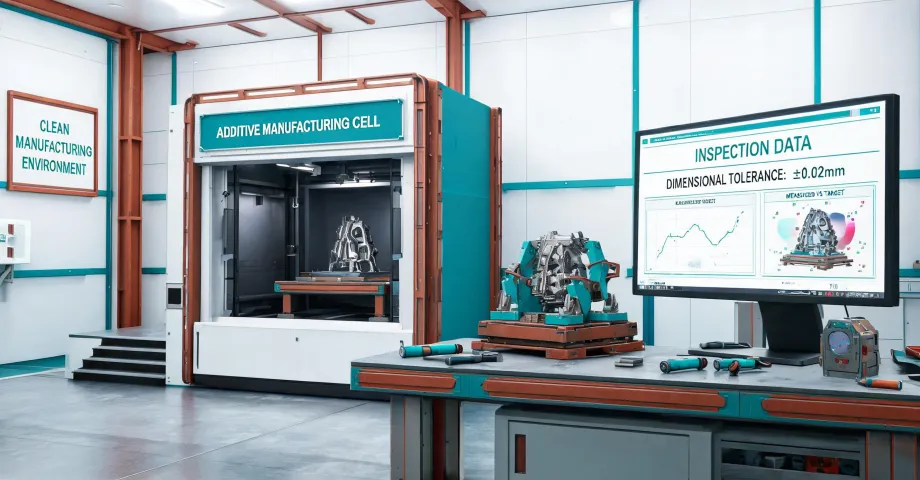
CNC machining produces parts with tight tolerances (±0.02mm for standard work). Every part from the same program is essentially identical, assuming tool wear is managed properly. Machine shops can provide CMM reports to prove consistency.
Markforged 3D printing has improved significantly. The X7 series (Markforged's industrial flagship) achieves ±0.125mm tolerance in the XY plane—good for most functional parts. But Z-axis tolerance is typically ±0.200mm due to layer adhesion variability. For press-fit or mating applications, this may require secondary finishing.
In practice: For non-critical jigs, fixtures, and prototypes, Markforged parts are fully acceptable. For production parts with tight tolerances, CNC still has the edge. I've had clients reject 3D-printed parts because of surface finish variation—even though the parts functioned correctly.
When to Choose Each Approach
Based on my experience—and the mistakes I've documented—here's my practical guide:
Choose Markforged (or similar industrial 3D printing) when:
- Your volume is under 30–50 units, or you need iterative prototyping
- The part geometry requires internal channels or complex organic shapes
- Weight reduction is critical (aerospace, automotive performance parts)
- Lead time is the primary constraint (need functional parts in 24–72 hours)
- You want to test a design before committing to tooling
Choose traditional machining (CNC, laser cutting) when:
- Your volume exceeds 50 units (especially for simple geometries)
- You need tight tolerances (< ±0.1mm) or certified material properties
- The part will face cyclic loading or requires consistent mechanical performance
- You need full traceability and certification (aerospace, medical)
- Surface finish and cosmetic appearance are important
A hybrid approach often works best: Use Markforged for prototyping and low-volume production, then switch to CNC for scale-up. I've saved about $3,000 across several projects by printing first to validate the design, then machining for production.
Final Thought
The technology choice shouldn't be ideological. Markforged makes excellent industrial printers. CNC machining is a mature, reliable process. The right answer depends on your specific combination of volume, geometry, material requirements, and timeline.
One last piece of advice from someone who's paid for the education: always calculate total cost, not just per-unit cost. Include setup, material waste, and potential rework. I started using a simple spreadsheet after my third over-budget project. It caught a 40% cost overrun on a 100-unit order that would have been a disaster otherwise.
Prices and specifications mentioned are based on quotes from multiple vendors as of Q1 2025. Verify current rates and lead times with your chosen supplier before finalizing decisions.