It was March 2023, and our controller forwarded me a spreadsheet comparing Q4 tooling spend year over year. Carbide inserts—specifically the WNMG080404 we run on three of our turning centers—were up 41%. I remember staring at that number and thinking a few uncharitable things about our supplier.
For context: I manage procurement at a 140-person aerospace parts company. Roughly $4.2 million in annual spend. I've been doing this for seven years, and every invoice since 2018 lives in our cost tracking system. So when a line item jumps 41%, I notice.
That spreadsheet kicked off a 14-month evaluation that ended with us buying a Markforged industrial 3D printer—but not the one we originally wanted. The story has three parts, and the second one stung.
How it started: the 3D printing question we'd been avoiding
By early 2023, our CNC capacity was maxed out. We had a backlog of small-batch aluminum brackets and shop fixtures that kept getting pushed behind our higher-volume work. When I pulled the numbers, those "nuisance" jobs made up about 19% of our machine hours but only 7% of revenue. The math was ugly.
Our engineering lead had been pushing additive manufacturing for two years. I kept saying no. My assumption was that 3D printing was for prototypes and toys—not for parts that needed to hold tolerances and survive a customer audit.
Then I looked at the tooling data. If we could offload even a third of those fixture jobs to a printer, we'd free up roughly 2,100 machine hours annually. At our shop rate, that's real money.
So in April 2023, we started a formal Markforged 3D printer review. We reached out to their team, got a demo, and lined up two alternative vendors. I told everyone the same thing: I want a full three-year TCO picture, not a brochure.
The middle part: what actually happened
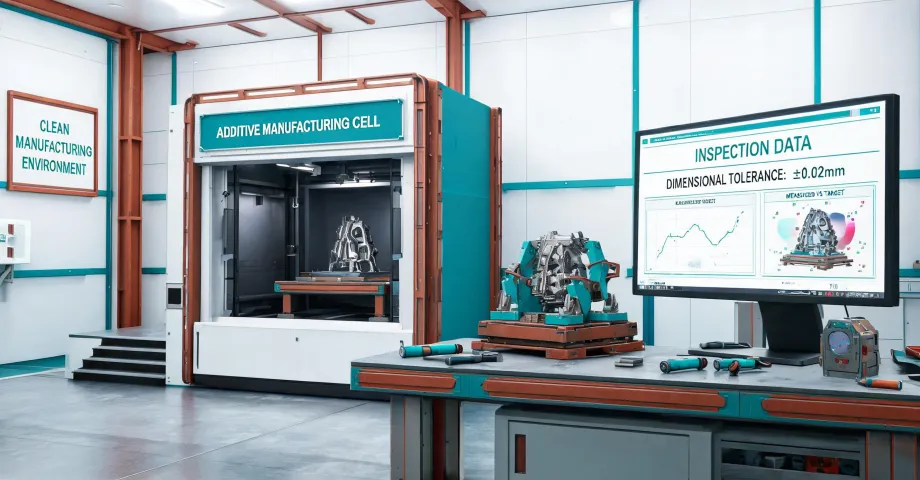
Weeks 1–3: demos and sample parts. We sent a fixture, a low-quantity bracket, and a small end-effector mount. Markforged quoted us a machine that uses Onyx and continuous carbon fiber—their industrial series. Roughly $162,000 for the system, materials, post-processing, and training over three years. That was higher than we'd budgeted.
Weeks 4–6: we compared printed samples against our CNC equivalents for tolerance and surface finish. The printed parts weren't as clean. But for fixtures and non-cosmetic brackets, they were good enough.
Week 7: site visits. We went to two shops running similar Markforged machines. One loved it. One had bought a machine two years earlier and it was "collecting dust" because they'd assumed it would replace their mill. That second visit probably saved us $90,000.
Here's where I made a mistake. During week 8, we had a customer requesting a change to a bracket tolerance. We'd worked with them for three years—I knew their engineer personally. I thought, "We've done this dance before, no need for a written change order." I skipped the formal confirmation.
The verbal agreement got lost in their engineering department's turnover. We ended up scrapping a small CNC batch. $4,100 gone. Nobody was at fault but me. The lesson: the moment you assume a relationship replaces documentation is the moment you get burned.
That same week, we also found out something about our carbide inserts. We'd switched to a "wholesale CNC lathe machine parts" supplier in 2022 to save on unit cost—about 12% cheaper than our previous vendor on WNMG080404 inserts. But surface finish complaints had quietly climbed from 2 per quarter to 9. When our machinist finally traced it back, the insert grade was inconsistent batch to batch. Cheap inserts cost us roughly $8,600 in rework and wasted cycles across 18 months. The "savings" were $1,400.
I'll say what I should have known earlier: people assume the cheaper vendor is cheaper. In practice, the vendor with consistent quality can charge less over time, because you stop paying the hidden tax of rework. The causation runs backward from what most procurement folks think.
The turn: what we got wrong about 3D printing
Around month 4, we did a full cost model. And the results were… not what we expected.
For high-volume aluminum parts—anything above 500 annually—CNC machining still wiped the floor with additive. The per-part cost of printing was 2–4x higher. Even accounting for the machine hours we'd free up, the economics didn't work at that scale.
But for low-volume, geometrically complex parts—30 units or fewer, often with internal channels or lattice features—the printed version was 30–65% cheaper per part than our current CNC path. And lead time dropped from 3 weeks to 6 days.
That's the real story. Not "3D printing replaces machining." Not "one machine does everything." It's a specialist tool that wins on a specific slice of the work.
I remember our engineering lead saying, "So it's not about replacing CNC. It's about deciding what shouldn't be in the CNC queue at all." That single sentence changed how I structured the purchase.
We also looked at laser welding certification because two customers had asked about it. After getting pricing—around $34,000 for equipment, training, and audit prep, plus 8 months of someone's attention—we shelved it. That's a scope we don't have. Maybe in 2026. Admitting that out loud felt better than pretending we could half-do it.
The result: a smaller check, a better fit
In the end, we bought a smaller Markforged model—the one tuned for tooling and low-volume composite work—for about $103,000 total. We kept all high-volume machining in-house. We also switched back to the previous carbide supplier, at a slightly higher unit price, and cut rework cost by roughly $5,800 per year.
One year in, the results:
- CNC tooling spend down 14%, mostly from fixtures no longer consuming insert life
- Fixture lead time dropped from 18 days to 6
- Roughly 1,800 machine hours returned to production work
- Zero customer complaints on printed parts
Not everything went perfectly. We had one printed part fail a fit check because our CAD model had a tolerance stack we'd masked in CNC. That cost us a week. But the failure was on our end, not the machine.
The vendor who told us "don't buy our biggest machine for this—start smaller" is the one we now call first for everything else. To me, that's the signal. The best suppliers will tell you what they're not good at. The worst will tell you they're good at everything.
What I'd tell another procurement manager
Track total cost, not sticker price. Ask every vendor where their capability ends. And if a supplier says yes to every request without hesitation, treat that as a yellow flag, not a green one.
Also—get the written confirmation. Even from people you trust. Especially from people you trust.