I'm not going to sugarcoat it: if you're a manufacturing engineer deciding between a standard carbon fiber 3D printer and an industrial-grade Markforged system, the price difference can feel like a punch in the gut.
But after coordinating over 200 rush production jobs across aerospace, automotive, and medical device clients, I've learned something that changed how I look at every equipment purchase. In urgent situations, paying premium for certainty isn't just worth it. It's often the only rational choice.
This isn't about which printer brand is better. It's about what happens when a deadline is shrinking, a client's line is down, and the cheapest solution suddenly carries the highest risk.
What "Rush" Really Means in Manufacturing
In my role coordinating emergency production for a contract manufacturing partner, I've developed a sort of triage mindset. Every request gets filtered through three questions, in this order: How many hours are left? Can this realistically be done in that window? And what's the worst-case outcome if we guess wrong?
Let me give you a concrete example. In March 2024, we had an aerospace client lose a critical jig just days before a qualification audit. The original part was traditionally machined from aluminum. The lead time for a replacement was four weeks. That wasn't going to work.
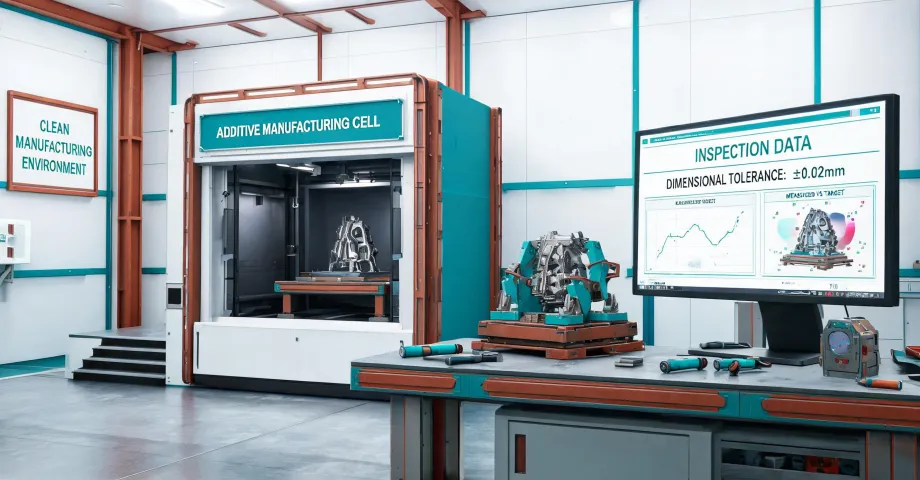
We pivoted to additive manufacturing. The geometry was complex enough that we couldn't risk a desktop-level composite printer. We needed a platform with a track record for the material properties we had to guarantee. The Markforged X7, running Onyx with continuous carbon fiber reinforcement, became our path forward.
The part was printed, post-processed, inspected, and delivered in 72 hours, within spec. Did we pay more per part than a machined equivalent? Absolutely. Was it worth it? The client's alternative was missing the audit window, which carried a contractual penalty that eclipsed every machine cost we'd spent that month. Not even close.
This is the part I think a lot of procurement teams miss. The premium isn't actually for speed. It's for determinism. Speed without reliability is just a gamble with a tighter timeline.
Markforged and What I Look For in an Industrial System
Before anyone accuses me of shilling for a specific brand, let's be clear: the characteristics I value in an emergency are the same ones that matter for standard production. When a system is positioned as industrial-grade, it needs to deliver on several specific promises, not just in an ideal print lab, but under operational pressure.
Spoiler warning, though: I don't have hard data on industry-wide failure rates for every printer on the market. But based on my hands-on experience running parts across several platforms, my sense is that a controlled, enclosed system with industrial components consistently reduces first-print failures on demanding geometries.
Here's why Markforged has become a fixture in our facility, and why I'll recommend them to colleagues facing emergency work:
1. Predictable Machine Personality
Every machine has a personality. The question is whether that personality creates predictable outcomes. In our experience, the Markforged systems held tolerances without constant fiddling. That's crucial when there's no time to run a calibration test two or three times.
When I'm triaging a rush order, I don't care about the "cool" features on the spec sheet. I care whether the print I start tonight will be right tomorrow morning. If I have to watch the first layers like a hawk because the machine is finicky, then I'm not really saving time. I'm just adding stress.
2. Carbon Fiber Without Excuses
Carbon fiber 3D printing gets thrown around a lot. But continuous carbon fiber reinforcement is a different ballgame from a chopped carbon fiber fill. The short-punch version? Continuous fibers sound expensive because they are — and they perform accordingly.
For the jig I mentioned, we needed stiffness and heat resistance we wouldn't trust from a pure polymer part. The continuous reinforcement wasn't a luxury add-on. It was the whole point of using the platform. The metal-like thermal and structural stability of those parts is precisely why the system spends so much time on the floor of shops like ours.
3. A Segue That's Actually Relevant
One question that always comes up is how to evaluate the printer market alongside other manufacturing equipment like UV printers, laser cutters, or even traditional press brakes. Sourcing industrial equipment — whether it's for marking, cutting, or forming metal — has become a global hunt. Some colleagues have even asked spec comparisons with tools in entirely different categories, looking for that one mythical machine that does everything.
Here's the thing. The industrial version of whatever you're buying, from a Markforged system to an electric press brake, is always about the workflow. A cheaper tool that requires a second shift of babysitting is not actually cheap. And in an emergency, that hidden labor instantly becomes a critical risk.
Markforged isn't a complete replacement for machining, any more than a laser cutter replaces a press brake. But as a dedicated platform for producing composite parts on demand, it's a tool that makes the phrase "one-week turnaround" sound like a generous vacation rather than a panic-inducing impossibility.
Why the Cheapest Solution Fails Under Pressure
Our company lost a $12,000 contract back in 2022 because we tried to save money by using a bargain-basement service for a rapid prototype run. The quote was about 30% lower than the industrial option. I won't name the vendor — no need to embarrass them — but the time it arrived, it had delaminated, the dimensions were out of spec, and the client had already signed with a competitor.
That experience is now embedded in our workflow. Our company policy now requires a 48-hour buffer on any deadline-critical order. And if we don't have that buffer, we don't gamble on budget options. We'd rather pay express rates for a deterministic platform than spend weeks renegotiating a contract we already lost.
Now, you might be thinking: isn't this just an excuse to spend more money and call it strategy? Fair challenge. So let me address it directly.
Am I saying nobody should ever use a cheaper printer or a slower service? No. What I'm saying is that the cost equation changes when a failure creates secondary costs — an entirely missed event, a stalled production line, a lost aerospace qualification window. In those contexts, a "decent" machine that requires constant tinkering can become a real liability.
The mark of an industrial system isn't the marketing sheet. It's the repeatability of the output after the 50th print, after a hot week, after an engineer frantically changes the model at hour 40 of a 48-hour deadline.
That repeatability is the hidden feature. It's also basically impossible to quantify until you've seen both sides: the smooth "guaranteed" delivery that goes perfectly through the system, and the ugly "estimate" that shows up late and wrong.
Some Notes on AI and the Future of Additive Workflows
Let's circle back to the process side. There's a growing ecosystem of additive workcells out there, and AI-assisted toolpath and slicing are changing the speed at which operators can iterate. The Markforged Digital Source and similar cloud-based systems are making themselves relevant by integrating into this connected workflow. When a machine is networked and monitored, and when the toolpath is tuned to the specific part, engineers spend less time wrestling with printer settings and more time validating that the part will actually function.
My honest take? We haven't yet seen the full revolution of additive manufacturing in emergency repair. But every year, 3D printers and laser-based fabrication technologies creep further into standard production environments. What was once a novelty for prototyping is now a lifeline. And the ones that thrive won't just be the cheapest. They'll be the ones that deliver certainty.
Red Flags I Check on Every Industrial Quote
Here's what I actually do when evaluating whether a potential supplier or a new platform will be reliable. These are the questions I ask before I trust them with a deadline:
- Can they show me machine uptime data, not just spec sheets? Not everyone tracks this. The ones who do are usually the ones worth calling.
- Do they offer an enclosed print chamber? For engineering-grade thermoplastics like Onyx, stable heat is non-negotiable. An open-frame printer is a liability.
- What happens to the replacement parts for their printer when the machine churns out a million parts a month? Downtime for repairs can be the quiet killer of an entire production plan — and not all systems are created equal here.
- Do they have a defined supply chain for materials? A printer without certified materials is just a plastic extruder with a nickname.
And that's exactly why Markforged has been a focus for so many of us shipping parts in the aerospace and defense sector. Their platform and materials are validated as a unit. There is less in-house guesswork. And with the expanded material portfolio, including metal, the utility for building replacement parts and tools is expanding every quarter.
So, is the Markforged "worth it"? My answer is: if your business model depends on being the supplier who saves the day, the one other manufacturers keep on speed dial, then the cost of capability is an investment in your service pitch. The premium buys you repeatability, which is the only real currency when a client's line is silent and they're looking at a penalty for every hour of downtime.
The price of a X7 or FX10 model in the industrial series—those are visible and verifiable on their website, last updated Q1 2025, from what I've seen.
What isn't on the Markforged spec sheet is the cost of the moment, that exact moment you're in front of a client and their production manager is staring at you, and you need to say 'Yes, we can have this part by Thursday' — and then actually pull it off.
That moment favors preparation. It favors repeated, repeatable quality. And truth be told, it favors tools you already trust. For us, that tool has been a Markforged, and the decision to budget for industrial certification made all the difference.